
If you don’t feel like a bulldozer moving ever closer towards your dreams, pushing past obstacles like you were built for it, you probably have one or both of these problems:
- You’re not super clear on what your goals are and why, so you have no fuel.
- You don’t have a plan on how to get there, so you have no direction.
I’m going to show you how I solved those two problems for myself and friends over the last three years, and how you can do the same, so you can be and feel unstoppable.
The Mindset
Once I understood just how much time it takes to get truly good at anything, I figured that I can only be exceptional at one or two things in my lifetime. To me, this was quite liberating since it makes deciding what to spend my days on obvious.
To know what to do with your time, you need clarity on where you want to go in your life. I like to think in terms of decades since big dreams take a long time to realise, and so accepting that makes it easy to have razor focus for a very long time and to plan accordingly.
The caveat here is that you MUST care about the outcomes you want to work towards, they need to be things that you know you cannot live without. I insist on this, if you don’t care about the things you say you’re going to do to that level, you won’t plan for them, and even if you do, you won’t stick to it!
So, that’s the first step, get clear on the what and why.
The Method
Here is an exercise that I did to get crystal clear on what my goals were and why I wanted to achieve them. I compiled a list of everything I have ever wanted to achieve in my life, no matter how outrageous; there were 35 items on that list. Then, for each item, I asked myself three consecutive questions:
- What would happen if I did not achieve this?
- How would that affect my life?
- Would I be ok with that?
As an example, one of the goals on that list was becoming a chess grandmaster/being really good at chess. Here is how I appraised it:
- What would happen if I did not achieve this?
- I could not compete in high-level chess competitions.
- I would probably be spending very little time on chess.
- I would likely lose most, if not all, of the chess games I played.
- I may not improve my strategic thinking through chess.
- How would that affect my life?
- I would not get any praise for my chess abilities.
- I would not make any money from chess competitions.
- I would have more free time to pursue other things.
- I would feel bad if I keep losing at chess.
- Some people might make fun of me for not being good at chess.
- I would have to find other ways to improve my strategic thinking.
- Would I be ok with that?
- To me, after looking at it from multiple angles, the answer was obvious: Yes, I would be fine.
I don’t care enough for chess to make it a structured goal.
That did not mean I would never play chess again, or that I would never improve in the game, it just meant that I could make peace with the fact that it was not my life’s mission, I did not have to let it take up my mental real-estate.
I still play a game of chess or two here and there and I have improved at it a lot, but if I go a month or two without playing or improving, or if I lose a game, I won’t lose any sleep over it. To me, chess was not important enough to be a goal.
Now let’s look at a goal that I decided to pursue wholeheartedly, building my dream business:
- What would happen if I did not achieve this?
- I would likely be working a normal job.
- I would not be making as much money as I would like to.
- I would not be making the impact that I want.
- I probably would not have as much responsibility.
- How would that affect my life?
- I would likely be working a normal job.
- I would not be making as much money as I would like to.
- I would not be making the impact that I want.
- I probably would not have as much responsibility.
- Would I be ok with that?
- And once again, the answer was obvious: No, I would not be ok with that.
I could not envision a scenario where I was going to be ok with letting that dream go.
As I did this exercise, what I found was that many of the aspirations that I had listed fell apart pretty much immediately upon examination, like the chess example. I think I was holding on to these out of a fear of missing out instead of actually wanting the outcome, and once I saw that the consequences of not getting them were insignificant, it was easy to let go. That was 24 out of the 35 I had listed.
I feel the need to emphasise this point: almost 70% of the things that I thought I wanted to achieve, things that I thought were life aspirations, did not even survive 2 minutes of contemplation. It goes to show that, at least in my case, most of the things that were taking up my time, mental real-estate and energy were completely worthless! They were just keeping me from doing the things that I actually cared about.
You might ask, what of the remaining 11 items? Well, 9 of them were not immediately straightforward to classify, as in I found at least some value in the eventual outcome, so I had to evaluate them against each other at a later stage.
Only 2 out of the 35 were standout dreams that I saw no way of giving up, so those were the ones I immediately picked out. It’s insane to think that less than 6% of everything I’d ever told myself I wanted out of life actually mattered to me.
What I did at that point was plan out how much time and effort those two big dreams were going to take, and I filled out my calendar with them. It helps to think in terms of decades here. Most people overestimate what they can accomplish in one year, and underestimate what they can achieve in ten. That’s why finding the one or two things you care about the most is so important, because you must be in it for the long game.
Once I had planned everything I needed to do for my big goals, I planned the rest of my life around that. I planned when I ate, when I slept and for how long, when I called my parents, everything.
Having done all of that, I found that I still had some free time left. Amazing!
From there, I just repeated the appraisal process for the 9 remaining aspirations, and I was left with only 4 of them. At that point, I ranked them based on their importance, figured out what I needed to do to achieve them, and filled out the remaining time on my calendar with those actions until there was no free time left.
So by the end of this exercise, I found that I wanted to pursue only 6 out of the 35 things that I had originally listed (roughly 17%), which interestingly, correlates pretty closely with the Pareto Principle (80/20 rule), kind of neat!
And not just that, I had a very organised, actionable plan that I could follow right in front of me in calendar form; check it out!
I’ve included an example from a few years ago and one from today:
My Calendar a Couple of Years Ago:
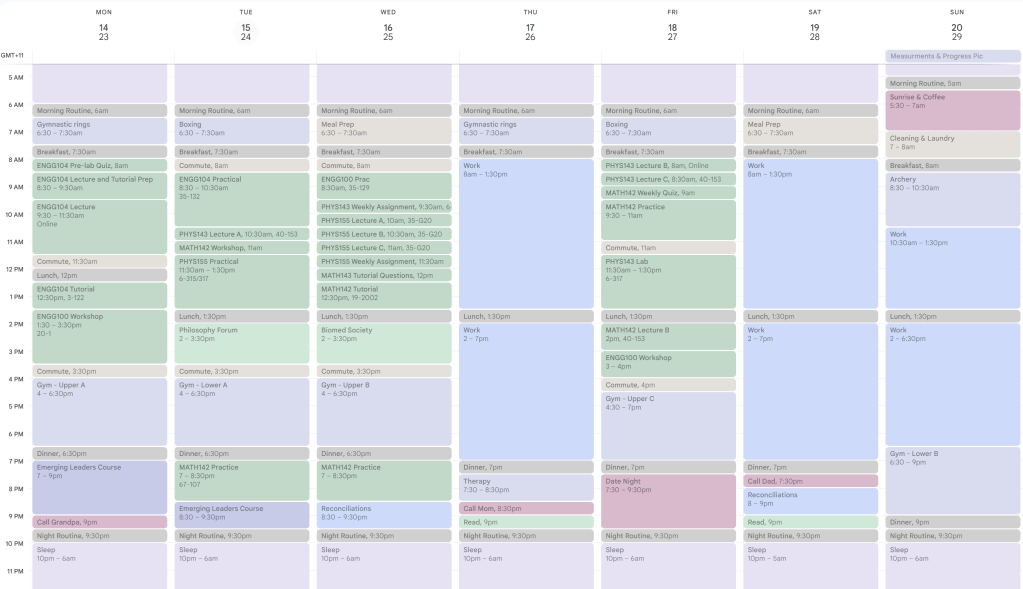
My Calendar Now:

Why You Should Do It Too
I did this exercise three years ago. From beginning to end, it took me less than half a day to complete. I have been using the same calendar, following the same goals for the last three years and counting, in fact I don’t think I will need to question my path for a very, very long time.
I’m telling you this because I want you to recognise one thing: This is extremely high-leverage work, where you put in less than 12 hours of work, and get years of clarity, certainty, direction and purpose out of it. There is no investment opportunity, no salary, no business, that has this kind of leverage. The return on this investment is incomprehensibly large, and you will only realise that once you have done it.
The specifics of what I do day-to-day may have changed over the last three years, but the goals themselves have not, and I have constantly been getting closer and closer to them.
If you are struggling with your direction in life, if you have too many things you want to achieve and not enough time to do it, please just set aside half a day to do this exercise.
This right here is unlimited motivation. It’s that feeling when you wake up with a fire in your belly, knowing exactly what you’re working toward, what you need to do—and being eager to do it. It’s not needing to force yourself out of bed or dragging through the day, but wanting to get up for it. It’s having a vision so clear, so deeply tied to who you are, that it’s impossible to stop working for it.
I know that sounds like an exaggeration, so you’re welcome to write it off as such, but to me the choice was obvious:
Put in less than a day of effort into something that is free and could change your life,
OR
Say it won’t work for you, and stay the exact same.
The choice is yours, but I would like to help you out as much as I can, so here is one last gift:
The 10 Steps For Unlimited Motivation
To make it even easier, here is a step-by-step checklist for the entire process. There is no excuse, all you need to do is set aside the time and follow these steps with absolute presence and focus.
- List out everything you think you want to achieve in life, and I mean all of it, no matter how out there it is; Just. Write. It. Down.
- Go through each item and ask yourself these three questions:
- What would happen if I did not achieve this?
- How would that affect my life?
- Would I be ok with that?
- Pick out the one or two things that you feel most strongly about based on your appraisal, you’ll know which ones they are when it’s in front of you.
- Discard the bottom 80% of the things that you care about the least.
- Take whatever is left over and set it aside for later. I’d recommend physically writing them down on a separate list.
- Now, figure out what you need to do to achieve those two big goals. If you don’t know what to do, you need to find out how, and that’s your task. A couple of notes here:
- Trying to find out what you need to do to achieve a goal IS progress towards that goal, it’s just the first step. Don’t think of this as the step before you start making progress, but rather as progress itself, because it IS!
- Think in decades, big dreams take time, but the good news is that these are the things you care about the most, so you CAN give yourself time to get there. Remember, most people overestimate the year and underestimate the decade.
- Fill your calendar with all the things that you need to do for the big goals. I like to use Google calendar, and that is what I recommend.
- Now, plan the other tasks you have to do in your life around what you need to do for your goals. Plan when you sleep and for how long, when you eat, when you visit grandma, everything. Your goals come first, everything else fits around that.
- After all of that is done, you will still have time left over in your calendar. Remember those leftover aspirations we did not discard? Rank them in order of importance to you.
- You can repeat steps 2 to 4 here, you’d be amazed at how short the list will be after that.
- Figure out what you need to do for item number 1 in the list, then put that in your calendar. If you have any time left, do that for item number 2 as well. Repeat until you have no more time left in your calendar.
That’s it! What you have now is all the goals that matter the most to you on a very deep level, and you have planned what you need to do to achieve them, when you need to do it, how often, and for how long!
Of course, what you need to do for each goal will change over time, and you’ll achieve some of the things you set out to do before others. The good news is that you can repeat these steps whenever you feel stuck and it will give you the clarity you need to get moving again. On top of that, you develop a system of planning, which makes you even better at this over time.
And you will fail, a lot. You won’t stick with your plan most days at first, as did I. You won’t feel like you’ve got it all figured out, you’ll feel like you’re not doing enough, and that’s ok, I went through all of that and more, and I want to tell you that it’s ok. Everything is a skill. The more you do it, the more you try, the better you get at it.
Don’t expect yourself to execute this perfectly at first. While the idea is for you to get closer to achieving your dreams, remember that you will struggle, and that’s the surest way to know that you’re on the correct path.
I speak from experience. Check out this article to see how I went from failing high school to a 4.0 GPA in university after 8 years of struggle and failure.

 Technical Executive Academy
Leave a comment